
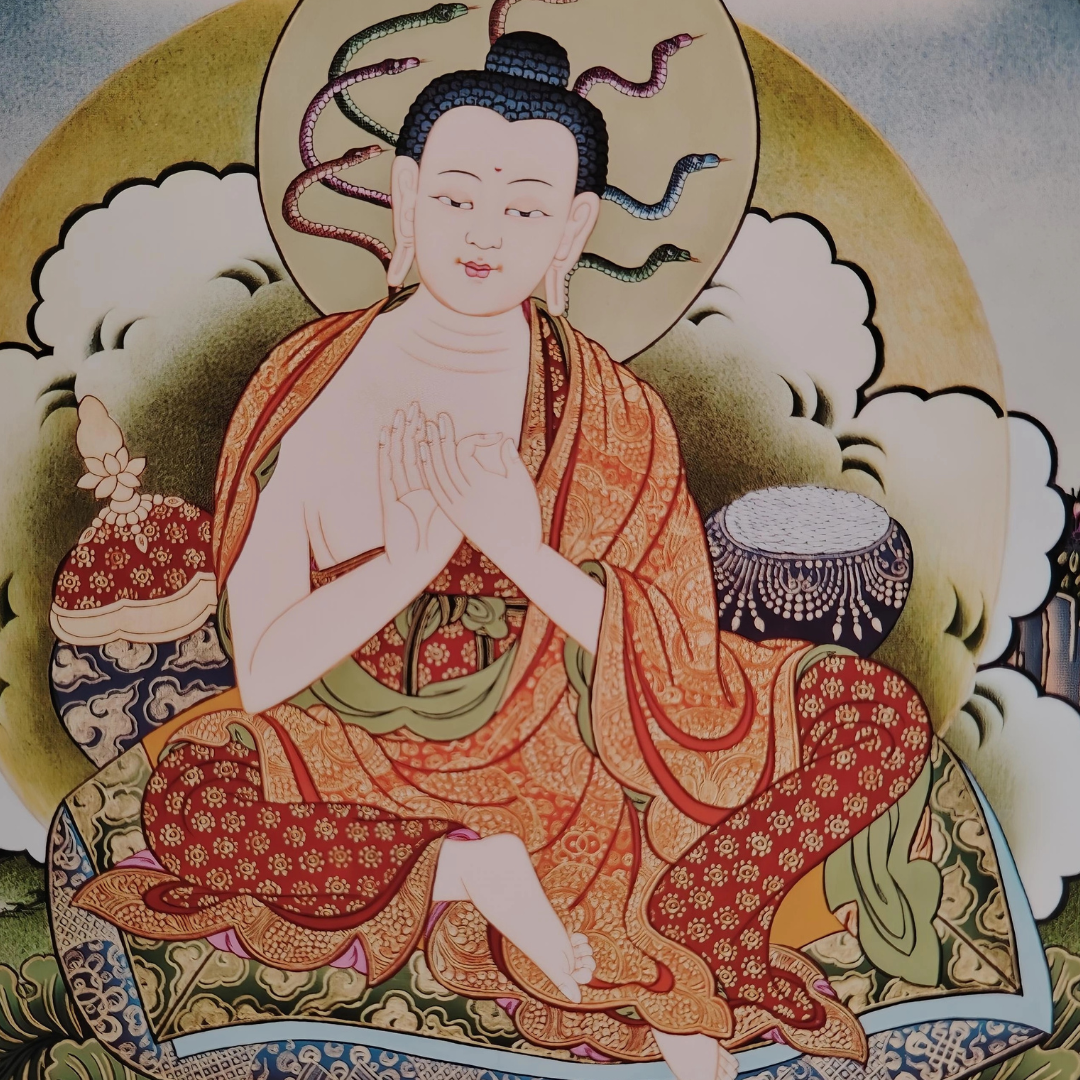
Madhyamaka Compassion in the Midst of Chaos
with Amelia Hall PhD
February 27 - March 27, 2026
with Amelia Hall PhD
How do we cultivate compassion and resilience without solid ground beneath our feet? Madhyamaka, developed by Buddhist philosopher Nagarjuna (ca. 150–250 CE), offers profound tools for understanding reality that remain relevant to our turbulent times.
Madhyamaka’s central insight: nothing possesses inherent, independent existence. Things arise through causes and conditions rather than existing as fixed entities. The teaching on “emptiness” (śūnyatā) isn’t nihilistic but liberating—because things lack fixed essence, they remain workable and responsive to change. By understanding how everything arises through interconnected conditions, we can work with reality as it is, loosening our grip on rigid positions and cultural divisions.
This course explores how these insights inform contemporary life, examining traditional arguments and their applications to relationships, social engagement, and finding stability in the face of uncertainty. Sessions combine the study of core principles with contemplative practice, making ancient wisdom accessible while respecting its philosophical depth.
Course Structure
Week 1: “The Middle Way Revolution” Begin with the historical Buddha’s middle way, situated between asceticism and indulgence, and then explore how Nagarjuna expanded this into a radical philosophical framework.
Week 2: “Emptiness Isn’t Nothing” Address the biggest misconception head-on. Use interdependence examples from ecology, economics, or relationships to show how things exist through connections rather than independent essence.
Week 3: “The Two Truths in Daily Life” Explore conventional vs ultimate truth through practical examples. Money has no ultimate essence but functions conventionally. Emotions feel solid but arise dependently. Show how understanding both levels reduces suffering – we can engage fully while holding lightly.
Week 4: “Deconstructing the Self” Using ‘analysis of self’ meditations to explore how the sense of “I” arises moment-to-moment through thoughts, sensations, and stories. Connect to modern psychology’s understanding of narrative identity. Show how this isn’t nihilistic but liberating: a less rigid self-concept means greater flexibility and compassion.
Week 5: “Living the Middle Way” Practical integration: how a Madhyamaka perspective transforms relationships, work, and spiritual practice, revealing how interdependence naturally gives rise to ethics, compassion, and joyful engagement.
Teaching Techniques
- Start each session with a brief meditation to ground the intellectual material in direct experience.
- Use breakout rooms for small group discussions on how concepts apply to personal situations.
- Include guided contemplations rather than just lectures – have students examine their own assumptions about permanence, independence, etc.
- Contemporary examples throughout – social media identity, climate interdependence, neuroscience findings about the self
Madhyamaka offers tools for navigating modern challenges like information overload (not grasping any view as ultimate), political polarization (seeing the constructed nature of positions), anxiety about the future (understanding the interdependent, ungraspable nature of outcomes), and consumer culture (recognizing the emptiness of the self that’s supposedly satisfied by purchases). The key is showing Madhyamaka not as abstract philosophy but as practical wisdom for reducing unnecessary mental suffering while remaining fully engaged with life.
Who Should Attend?
For serious practitioners seeking approaches adequate to today’s complexity, grounded in Buddhism’s most sophisticated philosophical tradition.
Program Tuition
$335 Standard Tuition
$235 Community Supported Tuition
Learn more about available financial assistance options and apply for a scholarship here.
Installment Payment Plan Option at Registration
Recognizing that everyone’s financial situation is unique, Tara Mandala strives to make its programs as accessible as possible. During registration, participants have the option to either pay the program fee in full or select the Installment Payment Plan. For those choosing the installment plan, a 25% deposit is required at registration, with the remaining balance automatically divided into equal monthly payments. The final payment is due 14 days prior to the program’s start date. If retreat enrollment occurs close to the start date, additional arrangements can be made. For any questions or special requests, the Finance Team is ready to assist at care@taramandala.org.
Sustaining Sangha
If you are currently a member of our Sustaining Sangha, you may apply your Online Program discount to this course. To learn more about Sustaining Sangha membership, benefits, and discounts, click here.
Offering dana to the Teacher
The practice of offering dana, which means “generosity,” is the traditional offering the student makes to the teacher as a symbol of appreciation, gratitude, and reciprocity for receiving the precious teachings. Information on offering dana to the teacher will be provided during the program. To learn more about dana and suggested dana ranges, please click here.
The suggested dana for this program is $50 – $150.
Program Schedule
Five (5) consecutive Fridays from February 27 to March 27, 2026, from 10:00 am to 12:00 pm MST/MDT. Important Time Zone Note: The USA observes Daylight Saving Time starting March 8, 2026. Therefore:
Sessions 1 & 2 (Feb 27 & March 6): Conducted in Mountain Standard Time (MST).
Sessions 3–5 (March 13, 20 & 27): Conducted in Mountain Daylight Time (MDT).
Please use this link to view how this daily schedule is translated into your time zone.
Recording Access
All participants will have 1-year access to the recordings.
Tara Mandala Pricing Guidelines
As we strive to become an equitable, diverse, and inclusive community, our pricing guidelines are designed to serve as a map, inviting each of us to assess the resources that contribute to our access to precious dharma teachings. While we do ask you to look inward, please know there is no right or wrong answer. We encourage you to select the range/rate that is most suitable for your circumstances. To learn more about Tara Mandala’s pricing guidelines for Online Programs, In-Person Retreats, and Special Promotions, please visit this page.
What is a Tara Mandala Online Program?
Tara Mandala offers online programming via live and pre-recorded curricula, providing you with the opportunity to access dharma teachings, engage in guided practice, experience personal retreats and hands-on learning, and connect with other participants through easy-to-use online platforms and an engaged community network. When needed, the program description and schedule will inform you in advance if and when a specific online session must be attended live, if a direct transmission (Tib. lung) may be given. Access to recordings of all sessions will be available for additional viewing for one year.
Online Programs Cancellation and Refund Policy
Mental Health Disclaimer
While Tara Mandala offers profound Buddhist teachings and a supportive spiritual community, we do not provide mental health services, and our teachers are not operating as mental health professionals. Spiritual guidance provided by a Tara Mandala teacher is not a substitute for professional mental health support. We honor the importance of mental well-being and encourage community members seeking support to connect with licensed professionals in their local area. For immediate assistance with mental health concerns, please contact your local crisis resources or emergency services.
About the Teacher